Agentic Shopping: How Google’s AI cart is reshaping e-commerce

Google has a clear idea of what the future of online commerce will look like – and traditional search ads will only play a minor role. With the introduction of the Universal Commerce Protocol (UCP), the search giant is ushering in a new phase of so-called Agentic Commerce: AI agents take over the entire purchase journey – from product discovery and selection to checkout.
Together with partners such as Shopify, Walmart and Target, Google aims to establish an open standard that enables AI systems to communicate directly with merchants. At the same time, Google is integrating personalized shopping ads directly into AI Mode – a clear move toward tighter control over monetization and transactions.
For merchants, this means one thing above all:
Product data becomes the decisive competitive factor.
What is the Universal Commerce Protocol (UCP)?
The Universal Commerce Protocol is designed to remove a major technical barrier in AI-powered commerce. Instead of building individual integrations for every webshop, AI agents will be able to access product information, availability, pricing, and checkout functionality through a single unified standard.
In the United States, direct purchasing is already a reality: users can order products directly from Gemini apps or Google AI Mode. Payment and shipping details are automatically pulled from Google Pay and Google Wallet, with PayPal expected to follow. A launch date for Europe or the UK has not yet been announced.
Personalized AI ads: Marketing at the moment of decision
Alongside the technical infrastructure, Google is expanding its advertising model. Instead of traditional search ads, the company is focusing on context-aware, personalized offers that appear precisely when users are actively discussing a purchase decision with an AI.
For example, if someone asks the AI for a compatible smartphone charger, they won’t just see verified products – they may also receive additional offers such as instant discounts or same-day delivery options.
These in-the-moment ads promise significantly higher conversion rates, but they also demand precise, structured, and up-to-date product data.
Agentic Commerce: Google is not alone
Google is not the only player pushing checkout experiences into AI environments:
- OpenAI continues to work on its own checkout capabilities, but has recently struggled with insufficient product data quality.
- Microsoft recently launched Copilot Checkout in the U.S. – claiming a 53% higher likelihood of purchase completion within the first 30 minutes.
- Amazon is going even further: under the name “Buy for me,” AI bots are expected to read product data from external shops and complete purchases directly within the Amazon app – in some cases without explicit merchant consent.
This example in particular highlights how quickly merchants can lose control over their product data if it is not managed centrally and strategically.
Keeping control of product data – more important than ever
As Agentic Commerce gains momentum, the balance of power in e-commerce is shifting. Merchants that provide the best product data are favored by AI systems. Those without control risk losing visibility, margins, and brand ownership.
Google itself is already introducing new data attributes in the Merchant Center to better prepare products for AI interfaces. These requirements include:
- consistent product descriptions
- structured attributes
- accurate real-time pricing and availability
- cross-channel data maintenance
Without a centralized system, this quickly becomes unmanageable. 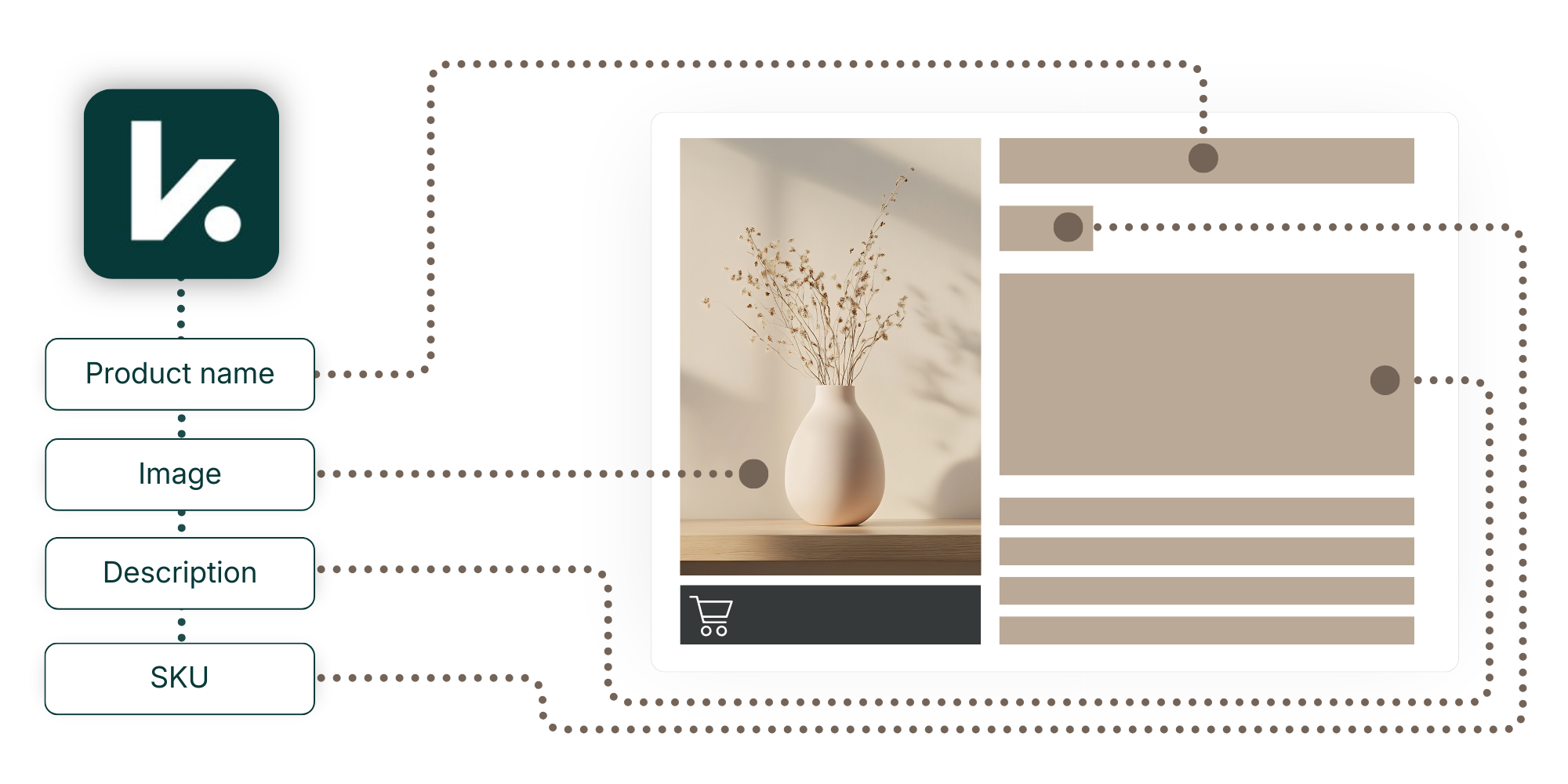
How Kontainer PIM plays a key role
A powerful Product Information Management (PIM) system is the foundation for success in this new commerce reality. Kontainer PIM helps companies manage their product data centrally, in a structured way, and independent of channels – ensuring they stay in control.
With Kontainer PIM, merchants can:
- deliver consistent product data to AI platforms, marketplaces, and webshops
- quickly add new attributes, for example for Google Merchant Center or AI ads
- accurately manage bundles, discounts, and variants
- significantly reduce time-to-market
Combined with Kontainer DAM, images, videos, and other media assets can also be managed centrally and distributed automatically. Learn more on our pages about Kontainer PIM and product and media data management.
In a world where AI agents actively influence purchasing decisions, clean, high-quality data is no longer a “nice-to-have” – it’s business-critical.
Conclusion: Agentic Commerce requires clear data strategies
Whether it’s Google, Microsoft, OpenAI, or Amazon, all major platforms are working to move the entire purchasing process into AI environments. For merchants, this means: If you don’t have control over your product data, you become interchangeable.
With a centralized data strategy and a system like Kontainer PIM, companies retain ownership of their content – and ensure their products are presented correctly, attractively, and profitably in AI-driven shopping experiences.
Frequently Asked Questions about Agentic Commerce & Product Data
1. What is Agentic Commerce?
Agentic Commerce describes the use of AI agents that independently search for and compare products and handle the purchasing process, including payment.
2. Why is product data becoming so important now?
AI systems make decisions based on structured data. Only those that provide complete, accurate, and up-to-date product information will be displayed prominently.
3. What role does Google play in this?
With the Universal Commerce Protocol, Google is creating a standard that allows AI agents to interact directly with stores and trigger purchases from AI interfaces.
4. How exactly does a PIM system like Kontainer help?
Kontainer PIM centrally collects all product information, ensures data consistency, and enables easy distribution to new channels and AI platforms.
5. Is Kontainer also suitable for international setups?
Yes. Kontainer supports multilingualism, variants, local requirements, and scales easily to international e-commerce structures.