The EU’s New Rules on AI-Generated Visual Content: What Every Marketer Must Know

The EU AI Act introduces mandatory transparency obligations for AI-generated images and visuals — including watermarking. Here’s what the regulation means, when it kicks in, and how Kontainer DAM makes compliance effortless.
Article Content
- What is the EU AI Act?
- The New Watermarking Requirement
- Who Is Affected?
- Timeline & Enforcement
- How Kontainer DAM Helps
- Compliance Peace of Mind
- Conclusion
1. What Is the EU AI Act — and Why Does It Matter to Marketers?
Artificial intelligence is reshaping how marketing teams create content. AI image generators, retouching tools, and generative design platforms have made it faster and cheaper than ever to produce stunning visuals. But alongside this creative revolution comes a new regulatory reality.
The EU Artificial Intelligence Act (Regulation (EU) 2024/1689, commonly called the “AI Act”) is the world’s first comprehensive legal framework governing the use of AI. It was formally adopted by the European Parliament in March 2024 and entered into force on 1 August 2024. Its provisions are being rolled out in phases, with the full set of rules becoming enforceable on 2 August 2026.
The AI Act takes a risk-based approach: the higher the potential harm of an AI application, the stricter the requirements. Transparency obligations — including the labelling and watermarking of AI-generated content — sit at the heart of the regulation’s consumer protection goals. The aim is straightforward: people have a right to know when what they are seeing was created by a machine, not a human.
The EU AI Act applies to any organisation that places AI systems on the EU market or uses AI in a professional context within the EU — regardless of where the organisation itself is headquartered. If your marketing materials reach European audiences, this regulation applies to you.
Official EU Resources
- EU AI Act — Full Legal Text (EUR-Lex)
- European Commission: AI Policy Overview
- Code of Practice on AI-Generated Content — EU AI Office
- European Parliament: AI Act Explainer
2. The New Watermarking Requirement for AI-Generated Visuals
The core transparency obligation for AI-generated images is set out in Article 50 of the AI Act. It establishes that providers of AI systems capable of generating synthetic content — including images, video, audio, and text — must ensure their outputs are marked in a machine-readable format that identifies the content as artificially generated or manipulated.
In parallel, the European Commission launched a dedicated Code of Practice on the Transparency of AI-Generated Content in November 2025. The first draft of this Code was published on 17 December 2025 and is expected to be finalised by May–June 2026.
What exactly must be done?
The draft Code of Practice makes clear that no single marking technique is sufficient on its own. Instead, it mandates a multi-layered approach to watermarking and labelling:
Metadata Embedding
Machine-readable provenance information — who created the content, when, and with which AI system — must be embedded directly into the file using standards such as C2PA.
Imperceptible Watermarking
An invisible watermark must be woven into the image at the pixel level. This watermark must survive common processing steps such as compression, cropping, and format conversion.
Fingerprinting & Logging
Where other marking techniques fall short, providers must maintain logs or digital fingerprints that allow content to be traced back to its AI origin after the fact.
Human-Readable Disclosure
Deployers — meaning the organisations that actually use AI-generated content in their communications — must clearly disclose to audiences when visuals are AI-generated or AI-manipulated.
The Code also requires that watermarks be explicitly protected in platform terms of service: deliberately removing or altering an AI watermark will be prohibited. This means marketing teams cannot simply strip a watermark before publishing an image.
Penalties for Non-Compliance: Failure to comply with Article 50’s transparency obligations can result in fines of up to €15 million or 3% of total global annual turnover, whichever is higher. For marketing departments managing large volumes of AI-generated visuals, the compliance stakes are very real.
3. Who Is Affected? Understanding “Providers” vs. “Deployers”
The AI Act draws an important distinction between two types of actors, each with different obligations:
Providers
These are the companies that develop and supply AI systems — think of OpenAI (DALL·E), Adobe (Adobe Firefly), Midjourney, and Stability AI. Providers carry the primary technical obligation: they must ensure their AI systems embed machine-readable watermarks and provenance data into every image they generate.
Deployers
These are the organisations that use AI tools in their professional activities — which includes virtually every modern marketing, communications, or creative team. Deployers do not need to engineer watermarking systems themselves, but they do carry important obligations:
- They must disclose to audiences when AI has been used to create or significantly alter visual content.
- They must ensure that AI-generated visuals used in their communications carry the appropriate markings, and must not remove or suppress them.
- They must implement internal governance processes — including staff training and content workflow controls — to ensure consistent and reliable compliance.
- Private individuals using AI tools for purely personal purposes are exempt; the obligations apply to professional and commercial use.
In practice, this means that a marketing team downloading an AI-generated product image and distributing it via their website, social channels, or press kit is acting as a deployer under the AI Act — and must ensure the image’s watermark and provenance data remain intact.
4. Timeline: When Do These Rules Come Into Force?
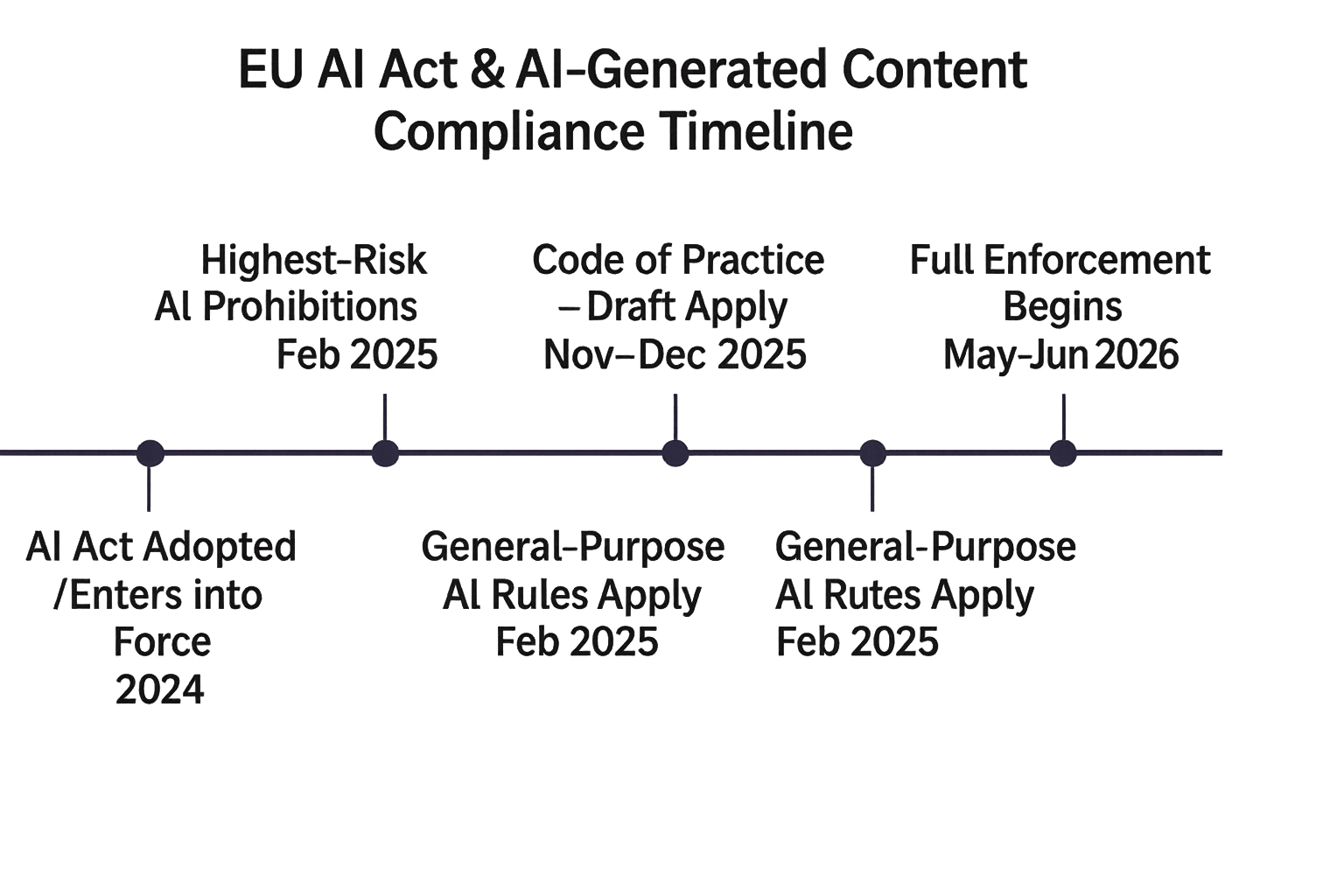
2024 — AI Act Formally Adopted
The European Parliament adopted the AI Act in March 2024. It entered into force on 1 August 2024. Prohibitions on highest-risk AI applications took effect in February 2025.
Aug 2025 — General-Purpose AI Rules Apply
On 2 August 2025, governance and transparency rules for general-purpose AI models (like the large language and image-generation models powering most creative AI tools) came into force. Providers of AI systems with synthetic content generation had to begin working towards compliance.
Nov–Dec 2025 — Code of Practice Launched
The EU AI Office launched the multi-stakeholder process to develop the Code of Practice on AI-Generated Content. The first draft was published on 17 December 2025, outlining the multi-layered watermarking expectations.
May–Jun 2026 — Code of Practice Finalised
The final Code of Practice is expected to be published, giving providers and deployers a definitive compliance roadmap ahead of the August enforcement deadline.
Aug 2026 — Full Enforcement Begins
Article 50 transparency obligations — including the watermarking and labelling of AI-generated content — become fully enforceable. This is the critical deadline for all marketing teams using AI-generated visuals.
The message is clear: Organisations that have not yet thought about AI content governance need to act now.
5. How Kontainer DAM Makes Compliance Effortless
For many marketing teams, the reaction to new regulations is a familiar one: concern about complexity, manual processes, and the risk of human error. The good news is that Kontainer DAM is specifically designed to handle exactly these kinds of compliance requirements — automatically, at scale, and without adding friction to your creative workflows.
1. Automatic C2PA watermarking
Set it up once, and you’re done. Kontainer applies the C2PA watermark automatically through your download templates, so every file exported with those templates includes the machine-readable provenance data the AI Act requires — without any manual work.
2. Visible AI icon on images
When content is fully or partially AI-generated, you can place a visible AI label directly on the image itself. The icon stays in place on every export — no matter the file format, crop, or size — ensuring your content remains compliant wherever it’s published.
3. AI detection & tagging
Each asset now includes an info panel indicating whether it is AI-generated. If Kontainer hasn’t identified this automatically, you can assign the AI status yourself — giving you a clear overview of which assets still need labelling before they go live.
4. Access Control and Approval Workflows
Kontainer DAM’s role-based access controls and approval workflow features mean you can require human review before AI-generated assets are approved for external use. This directly supports the internal governance requirements the EU’s Code of Practice places on deployers: the obligation to have human oversight of content labelling decisions.
- ⬇️ Automatic on Download
Watermarks are applied at the moment of download or distribution — no manual steps required from your team. - 🗂️ Rich Provenance Metadata
Store C2PA content credentials alongside AI origin, creation date, and tool information directly in the asset record for full auditability. - 🔐 Controlled Distribution
Role-based permissions and approval flows ensure only reviewed, properly labelled assets are distributed externally. - 📊 Audit-Ready Reporting
Track who downloaded what, when, and in which format — providing the documentation trail regulators may request.
Think of Kontainer DAM as your compliance safety net for visual content. The moment an AI-generated image enters your Kontainer library, you have a system that manages its marking, its metadata, its access rules, and its distribution history — automatically and without burdening your creative team.
6. Working with Confidence: How Kontainer Protects You Across All Compliance Areas
AI watermarking is the latest in a growing list of regulatory requirements that marketing and communications teams must navigate. Kontainer DAM was built with this reality in mind — not as a series of bolt-on features, but as a platform where compliance is woven into the core of how assets are managed and distributed.
Data Security and GDPR
Kontainer is fully GDPR compliant, with ISO-certified hosting infrastructure, role-based access control, and complete audit logging. Your asset library — and the personal data associated with it — is protected to the highest European standards. You can work knowing that who accesses what, and when, is always on record.
Licence and Consent Management
With Kontainer’s built-in photo consent tool and licence management features, you can attach consent agreements directly to assets and set expiry rules that prevent unlicensed images from being downloaded after their rights period ends. No more spreadsheet chasing or anxious searches through email threads to verify whether a photograph is still cleared for use.
ESG and Sustainability Documentation
As ESG reporting becomes mandatory under the EU’s Corporate Sustainability Reporting Directive (CSRD), Kontainer’s PIM and DAM capabilities help teams organise and evidence their sustainability claims with structured, auditable data — from product materials to supply chain imagery.
AI Watermarking — Automatic and Scalable
And now, as the EU AI Act’s transparency obligations come into force, Kontainer DAM adds AI watermarking to the same compliance ecosystem — applied automatically, consistently, and without adding a single extra step to your team’s day.
- Less time on compliance administration — automation handles the repetitive, error-prone steps.
- Fewer legal risks — rights, consents, watermarks, and access controls are enforced at the system level.
- Faster creative workflows — your team spends time creating, not checking spreadsheets or chasing approvals.
- One source of truth — every asset, every piece of metadata, every compliance record, in one place.
- Peace of mind — whether it’s GDPR, image rights, ESG documentation, or AI labelling, Kontainer has it covered.
The result is a marketing team that can move quickly and creatively — confident that the system beneath them is quietly ensuring every asset they use is compliant, correctly labelled, and properly governed.
7. Conclusion: Get Ahead of the Deadline
The EU AI Act’s watermarking and transparency obligations represent a significant — and sensible — step towards a more trustworthy digital information landscape. For marketing teams that work with AI-generated visuals, the question is not whether to comply, but how to do so without creating new burdens or bottlenecks.
Kontainer DAM offers the answer: a platform that embeds compliance into the fabric of your asset management workflows, applying the right watermarks and metadata automatically, at the right moment, every time. Your team keeps moving at the speed of modern marketing. Your organisation stays on the right side of the regulation.
With the August 2026 enforcement date approaching, now is the time to review how your organisation manages AI-generated visual assets — and to make sure the systems you rely on are ready.
Ready to make AI compliance effortless?
See how Kontainer DAM handles watermarking, metadata, and rights management — automatically.
Frequently asked questions about the EU AI Act and Kontainer
Does the EU AI Act require watermarking on AI-generated images?
Yes. Article 50 of the EU AI Act requires that AI-generated images, video, and audio be marked in a machine-readable format to identify them as artificially generated. The regulation becomes fully enforceable on 2 August 2026. The EU’s draft Code of Practice on AI-Generated Content, published in December 2025, specifies that a multi-layered approach is required — including embedded metadata, imperceptible pixel-level watermarks, and fingerprinting — with no single technique being sufficient on its own.
Who is responsible for watermarking AI-generated marketing images under the EU AI Act?
Responsibility is shared between providers and deployers. AI tool providers (such as Adobe Firefly, DALL·E, or Midjourney) must embed machine-readable watermarks at the point of generation. Deployers — including marketing teams and brands that use AI-generated visuals in professional communications — must ensure those watermarks remain intact, disclose to audiences when content is AI-generated, and implement internal governance processes to ensure consistent compliance. Deliberately removing or altering an AI watermark is prohibited.
What are the penalties for not labelling AI-generated content under the EU AI Act?
Failure to comply with the transparency obligations in Article 50 of the EU AI Act can result in fines of up to €15 million or 3% of total global annual turnover — whichever is higher. These penalties apply to both AI system providers and professional deployers of AI-generated content. With the August 2026 enforcement deadline approaching, organisations using AI-generated visuals in their marketing or communications should ensure they have a compliant workflow in place.
How can a DAM system help with EU AI Act watermarking compliance?
A Digital Asset Management (DAM) system like Kontainer can automate the watermarking process so it happens at the point of download or distribution — without requiring any manual steps from your team. Kontainer DAM allows organisations to store AI-generated assets with full provenance metadata, apply watermarks automatically whenever an image is downloaded or shared, tag and manage AI-generated content separately from other assets, and maintain an audit trail of who accessed or distributed each file. This makes it straightforward to demonstrate compliance without disrupting creative workflows.
When does the EU AI Act watermarking requirement come into effect?
The EU AI Act entered into force on 1 August 2024, and its transparency obligations under Article 50 — including watermarking and labelling requirements for AI-generated content — become fully enforceable on 2 August 2026. General-purpose AI model governance rules have applied since 2 August 2025. The EU’s Code of Practice on AI-Generated Content, which provides detailed technical guidance on watermarking implementation, is expected to be finalised in May–June 2026. Organisations should prepare their AI content governance workflows ahead of the August 2026 deadline.