Machine-Readable Brand Guidelines: Why AI-Ready Brand Management Matters
Article content
- 1. What are machine-readable brand guidelines?
- 2. Why brand guidelines must be AI-ready now
- 3. Tone of voice and text: the do’s and don’ts AI needs
- 4. Visual identity: logos, fonts, colours, icons and spacing
- 5. Why structure matters: marking brand properties correctly
- 6. Built for people, readable by machines
- 7. How Kontainer makes your brand AI-ready
- 8. Getting started: a checklist
Generative AI has become one of the most productive content creators in many organisations. It drafts product descriptions, writes newsletters, suggests social posts, builds presentations and generates campaign visuals. The question is no longer whether AI will create content on behalf of your brand. It is whether that content will actually look, sound and feel like your brand.
The answer depends on one thing: whether AI can read and apply your brand guidelines as precisely as your best designer or copywriter would.
1. What are machine-readable brand guidelines?
Machine-readable brand guidelines are brand standards stored as structured, clearly labelled data instead of pages in a PDF. Every rule, whether it is a HEX code, a font weight, a minimum logo size or a word your brand never uses, becomes a defined brand property that AI tools can retrieve and apply directly, without a person translating it first.
They do not replace the inspiring, visual brand guide your teams browse. They are the structured layer underneath it. The same brand knowledge, presented beautifully for people and precisely for machines.
Systems that manage this are increasingly described as AI-ready brand management platforms: brand platforms and brand portals that serve both human users and AI tools from one single source of truth.
2. Why brand guidelines must be AI-ready now
For decades, brand guidelines were written for people. A designer could open a PDF, understand the intention behind a rule and use good judgement when a situation was not covered. AI does not work that way. A static PDF on the intranet is easy for people to read, but practically invisible to the language models and AI agents producing more and more of your content.
When AI cannot access your rules, it guesses. The results are familiar to many marketing teams:
- Generic copy that could belong to any company
- Colours that are close to your brand palette, but not quite right
- Outdated or distorted logo versions
- Fonts replaced by whatever is available
- Product names spelled inconsistently across markets
- Claims or promises your legal team never approved
Many teams try to solve this with prompts, pasting brand instructions into every AI chat. But prompting is not infrastructure. Everyone uses their own version, instructions go out of date, and agencies and distributors never see the latest changes. The more content AI produces, the faster small inconsistencies add up to a diluted brand.
3. Tone of voice and text: the do’s and don’ts AI needs
Language models are excellent at adapting style, but only if they know exactly which style to adopt. Vague guidance like “we are friendly and professional” leaves far too much room for interpretation. AI-ready tone of voice guidelines break the brand voice down into concrete, explicit properties:
| Brand property | Example rule |
|---|---|
| Voice attributes | Confident, not arrogant. Warm, not casual. |
| Preferred and banned words | Say “customers”, never “users”. Avoid “cheap”; use “affordable”. |
| Product and brand names | Always “Kontainer” with a capital K, never abbreviated. |
| Formality per market | Informal address in Danish and Swedish, formal address in German. |
| Claims and disclaimers | Never promise results in numbers without an approved source. |
| Do and don’t examples | Paired example sentences showing on-brand and off-brand phrasing. |
Do and don’t examples are especially valuable. They show AI the difference between on-brand and off-brand far more effectively than adjectives alone.
4. Visual identity: logos, fonts, colours, icons and spacing
Visual generation raises the stakes even further. When AI builds a banner, a slide or a social graphic, “use our blue” is not enough. It needs exact values and the actual approved files. AI-ready visual guidelines include:
- Logos: every approved variant, when to use which, clear space, minimum sizes and which backgrounds are allowed.
- Colours: HEX, RGB, CMYK and Pantone values, primary and secondary palettes, and approved colour combinations with sufficient contrast.
- Typography: font families, weights, sizes, heading hierarchy and fallback fonts for systems where the brand font is unavailable.
- Icons and illustrations: the approved icon library, stroke width, style and colour usage.
- Spacing and layout: paddings, margins, grids and corner radii, expressed as exact values.
- Imagery: photo style, cropping rules, subjects to feature and subjects to avoid.
The more explicit each property is, the less AI has to interpret, and the more consistent your brand becomes across every channel and market.
5. Why structure matters: marking brand properties correctly
Making a brand AI-ready is not about writing more guidelines. It is about structuring the guidelines you already have. Three principles make the difference:
- Explicit: rules are stated as exact values and clear instructions, not descriptions that require interpretation.
- Labelled: every property is named and categorised consistently, so both people and machines know exactly what a value represents and when it applies.
- Connected: rules are linked to the actual assets they govern. The logo rule points to the approved logo files, and the font rule points to the font files.
A fourth principle ties it all together: guidelines must always be current. When a rule changes in one place, it must change everywhere, for every person and every AI tool at the same time.
6. Built for people, readable by machines
Structure does not have to come at the expense of experience. People still need brand guides that inspire, explain the thinking behind the brand and make it easy to find the right asset. A spreadsheet of brand properties will never build brand love among employees, agencies and partners.
The real goal is one source powering both experiences: a visually appealing brand portal for people, and a structured, machine-readable layer for AI. Maintaining a separate “AI version” of your brand next to the human version only recreates the problem of outdated, inconsistent copies.
7. How Kontainer makes your brand AI-ready
Kontainer’s brand platform is built around exactly this principle. As a combined DAM and PIM system, Kontainer keeps your brand guidelines, brand assets and product information in one place, and lets you connect them to each other.
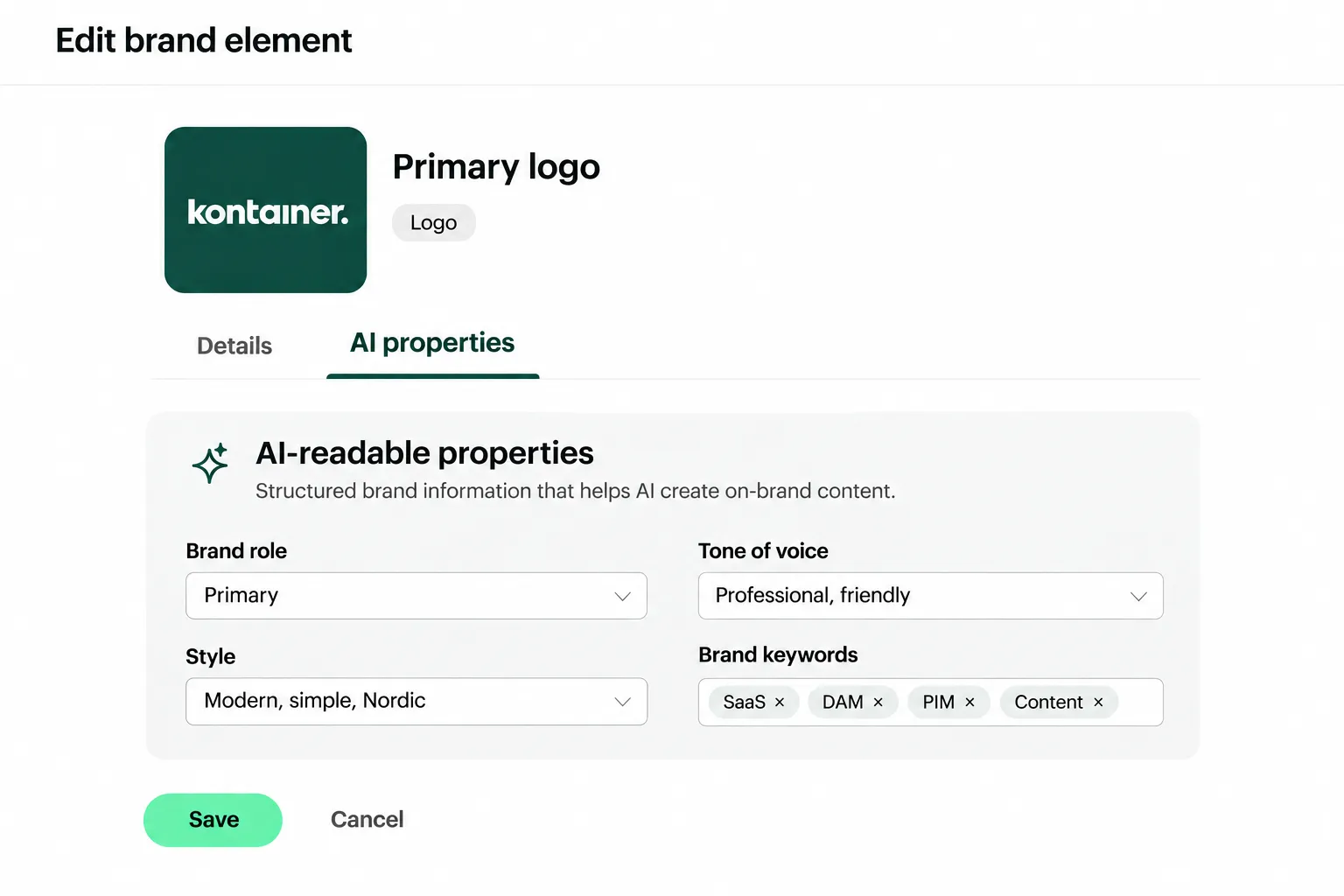
Detailed brand guides with structured brand properties. Create brand guides that define your fonts, colours, logos, icons, spacing and tone of voice as clear, structured brand properties rather than static text.
Fully intertwined with your assets. Brand properties live alongside the assets they describe in your DAM. The rules and the approved files are always connected and always up to date.
One set of properties, many uses. The same brand properties can be used in your communication, for tagging and organising assets in the DAM, and to build beautifully crafted brand portals for colleagues, agencies and distributors.
Direct access for AI through MCP. Kontainer offers an MCP server, so AI tools that support the Model Context Protocol can connect directly to your Kontainer platform. That means AI assistants work from the same approved brand properties and assets as your team, instead of guessing.
The result is a brand that is presented beautifully to people and understood precisely by AI, managed in one place.
8. Getting started: a checklist
- Collect your current brand guidelines, including PDFs, presentations and unwritten rules your team simply knows.
- Break every guideline down into explicit brand properties with exact values.
- Write concrete do and don’t examples for tone of voice and visual usage.
- Link each property to the approved assets it governs.
- Remove outdated versions so there is only one source of truth.
- Connect your AI tools to that source, so they always work with the latest rules.
- Review and update properties regularly as your brand evolves.
Want to see how it works in practice? Book a non-binding demo and we will show you how Kontainer can make your brand ready for both people and AI.
Frequently asked questions
What is AI-ready brand management?
AI-ready brand management is the practice of storing brand guidelines, brand properties and brand assets in a structured, connected system that both people and AI tools can use. It ensures that AI-generated text, images and layouts follow the same rules as content created by your team.
What is the difference between brand guidelines and machine-readable brand guidelines?
Traditional brand guidelines are written for people, often as PDFs. Machine-readable brand guidelines store the same rules as structured, labelled data with exact values, so AI tools can retrieve and apply them without human interpretation.
Do machine-readable guidelines replace a visual brand guide?
No. The best approach is one source that powers both: an inspiring, visual brand portal for people, and a structured layer for AI. That way, there is never a separate, outdated version of your brand.
What is an MCP server?
MCP, the Model Context Protocol, is an open standard that lets AI assistants connect to external systems and data. Kontainer’s MCP server lets compatible AI tools access your brand properties and assets directly from your Kontainer platform.
How do I make my brand guidelines readable by AI?
Break your guidelines into explicit brand properties with exact values, label them consistently, link them to the approved assets, and keep everything in one platform that your AI tools can connect to, such as Kontainer’s brand platform.